

One brain, two neurotypes, pulling in opposite directions at the same time. This is the three brain types, the spiky profile, the two epiphanies — and what actually helps.
From Spicy Burrito — Vale, the hands-free planner for neurodivergent brains. Researched 22–23 November 2026; every figure below is traceable to its source.
The short version
AuDHD is the word the community and many clinicians use when one person meets the criteria for both autism and ADHD. It is not a separate diagnosis — there is no "AuDHD" entry in the DSM-5-TR or ICD-11, so clinicians diagnose autism and ADHD separately, side by side. (AuDHD Council of Australia)
And it is not rare, and it is not just "autism plus ADHD added together". The two differences interact: they can amplify each other, hide each other, or pull in opposite directions in the same hour. Research increasingly treats the combined profile as having its own patterns (Antshel & Russo, 2019).
3–4 in 10 — Autistic people also have ADHD, going by pooled meta-analysis estimates of 28% to 38.5%. The often-quoted "50–70%" is a spread across individual studies, not a settled figure.
~1 in 5 — Children and teenagers with ADHD also meet the threshold for autism (21%, Hollingdale et al. 2020). Adult figures in this direction are not well established — anyone who gives you a firm adult number is guessing.
2013 — The year the DSM finally allowed autism and ADHD to be diagnosed together. Before that, the rulebook forced clinicians to pick one — and a generation of AuDHD people were only ever half-seen.
One honest note before we start: "neurotypical", "ADHD-only" and "autism-only" are not boxes people fit neatly into. Every brain type below is a spectrum, and every description is "often" or "commonly" — never "always". The differences that matter are about how much effort things take, how often, and what happens when the load rises.
The three brain types
Category one is the baseline. Category two is one difference, on its own. Category three is both differences at once — and that changes everything.
Category 1 — The neurotypical brain
The baseline: most systems running on autopilot. "Neurotypical" is not a diagnosis — it is shorthand for the pattern most people's brains follow. It does not mean an easy life, and neurotypical people get distracted, dislike change and feel drained after a big social day too. The difference is the effort it takes to recover.
Attention: Can usually be steered on purpose — even toward boring tasks — and brought back when it wanders. Working memory, impulse control and task-switching (the brain's "air traffic control") mostly run in the background.
Routine & change: Helpful, but not load-bearing. A changed plan or cancelled train is annoying, not destabilising. Habits form with relatively little conscious effort.
Sensory input: Background noise, lights and chatter are filtered automatically, so one conversation in a busy café can be followed without deliberate effort.
Social life: Reading tone, faces and unspoken rules runs largely below conscious awareness. A tiring day is usually reset by a night's rest — no scripting beforehand, no days of recovery after.
Category 2a — ADHD only
One difference: attention regulated by interest, not importance. ADHD attention is not broken — it is interest-led. Novelty, urgency, challenge and immediate reward switch it on; a boring, low-reward task can be genuinely hard to start, no matter how important it is. Lock onto the right thing and you get hyperfocus — time, hunger and everything else vanish.
Attention: Interest-, novelty- and urgency-led. Time blindness is real: deadlines feel distant until they are suddenly now. Working memory drops steps mid-task — "out of sight, out of mind".
Routine & change: Routines are hard to build and harder to keep — not hard to tolerate. Systems get built, used, abandoned and rebuilt. Sameness drains attention; novelty feeds it.
Sensory & movement: The brain often runs under-stimulated and seeks input. Fidgeting, pacing and doodling are not just restlessness — in lab studies, more movement during hard tasks went with better working memory (Sarver et al. 2015). Movement tops up alertness so the brain can think.
Social life: Difficulties are usually in-the-moment: interrupting, talking over people, missing a cue because attention drifted. Forgotten plans and late replies are executive-function problems, not a lack of caring. Intense pain at real or perceived rejection is widely reported.
Category 2b — Autism only
One difference: attention gathered deep, and a nervous system that feels the volume of the world. A leading autistic-led theory, monotropism, describes autistic attention as flowing into a few deep channels at a time — an "attention tunnel". Inside the tunnel: depth, detail, flow. Outside it: things get missed, and switching out costs real energy. (Monotropism is a theory, not a proven mechanism — the first systematic measure of it only appeared in 2023.)
Attention: Deep and narrow. Focused interests bring expertise, calm and joy — and are a way of regulating a nervous system that has had too much input.
Routine & change: Routine is load management, not preference. Every predictable piece is something the nervous system doesn't have to process from scratch. When a routine breaks, all that processing lands at once — which is why a late change can hit so hard.
Sensory input: A core diagnostic feature. Input can be amplified (lights, noise, textures feel overwhelming) or under-registered (not noticing pain, hunger or thirst). Load accumulates across the day — a room fine at 9am can be unbearable by 4pm. Overload can end in meltdown or shutdown; neither is a tantrum.
Social life: Conversation is often manual work: scripting, rehearsing, tracking faces, tone and turn-taking consciously, all at once. Many autistic adults love socialising — and still need long recovery afterwards. The cost, not the ability, is the clearest sign. Masking that cost away is linked to exhaustion, anxiety and depression.
Category 3 — AuDHD: both at once
The accelerator and the brake, pressed at the same time. The AuDHD brain needs predictability and is bored by it. It seeks stimulation and overloads fast. Attention is either all-in or gone, with a costly switch in between. A 2024 meta-analysis of executive function (36 studies) found the autism+ADHD group had more difficulties than the autism-only group, with a profile closest to ADHD-only — the combination is not a simple sum of its parts.
Attention: Monotropic depth and ADHD distractibility in the same head. Task paralysis is common: wanting to do the thing, knowing how, and still not being able to begin.
Routine & change: Wants the same breakfast every day and cannot keep a routine for three days. Both are true. What works is a flexible frame — predictable sequence, real choice inside it — not a rigid schedule.
Sensory input: Autistic sensitivity plus ADHD's weak filtering means overload arrives faster and is harder to predict. The same person can be overwhelmed by one sound and under-stimulated overall, at the same time.
Social life: Scripted and impulsive: rehearsing a conversation in advance, then blurting something out anyway. Double the effort, longer recovery. Very social one day, withdrawn for days after — that is overload and executive function, not flakiness.
Side by side
Attention — Neurotypical: Steered on purpose, brought back when it wanders. ADHD only: Interest-led; drifts or hyperfocuses; time blindness. Autism only: Deep, narrow tunnel; switching out is costly. AuDHD: All-in or gone; the switch itself is the hardest part.
Routine — Neurotypical: Helpful, not load-bearing. ADHD only: Hard to build and keep; novelty craved. Autism only: Load-bearing; late change can destabilise the day. AuDHD: Wants routine and is bored by it; needs a flexible frame.
Senses — Neurotypical: Background filtered automatically. ADHD only: Often under-stimulated; movement helps thinking. Autism only: Amplified and/or under-registered; load accumulates. AuDHD: Seeks stimulation and overloads fast; thresholds less predictable.
Social — Neurotypical: Cue-reading largely automatic. ADHD only: Impulsive and inattentive in the moment. Autism only: Manual decoding; genuine enjoyment, high recovery cost. AuDHD: Scripted and impulsive; double effort, longer recovery.
Burnout — Neurotypical: Tied to workload; rest usually resets it. ADHD only: Deadline cycles, under-stimulation, shame. Autism only: Chronic masking plus sensory and social load. AuDHD: Both loads at once; rest alone often isn't enough.
The spiky profile: why the AuDHD brain works harder
A spiky profile means a person's strengths and difficulties sit unusually far apart. A peak is a real strength. A trough is a real difficulty. And being brilliant at one thing says almost nothing about the next thing. The classic picture: someone who can memorise an entire train timetable but cannot follow a three-step verbal instruction. Who writes brilliantly but cannot reliably run a diary. That is not inconsistency of effort — it is the profile.
The term comes from UK assessment practice (Grant 2009; Doyle 2020), where occupational psychologist Nancy Doyle defined it as large, statistically significant gaps between the peaks and troughs of one person's abilities. A single overall score can hide it completely: two people can average out the same, one even across the board, the other swinging across roughly four standard deviations.
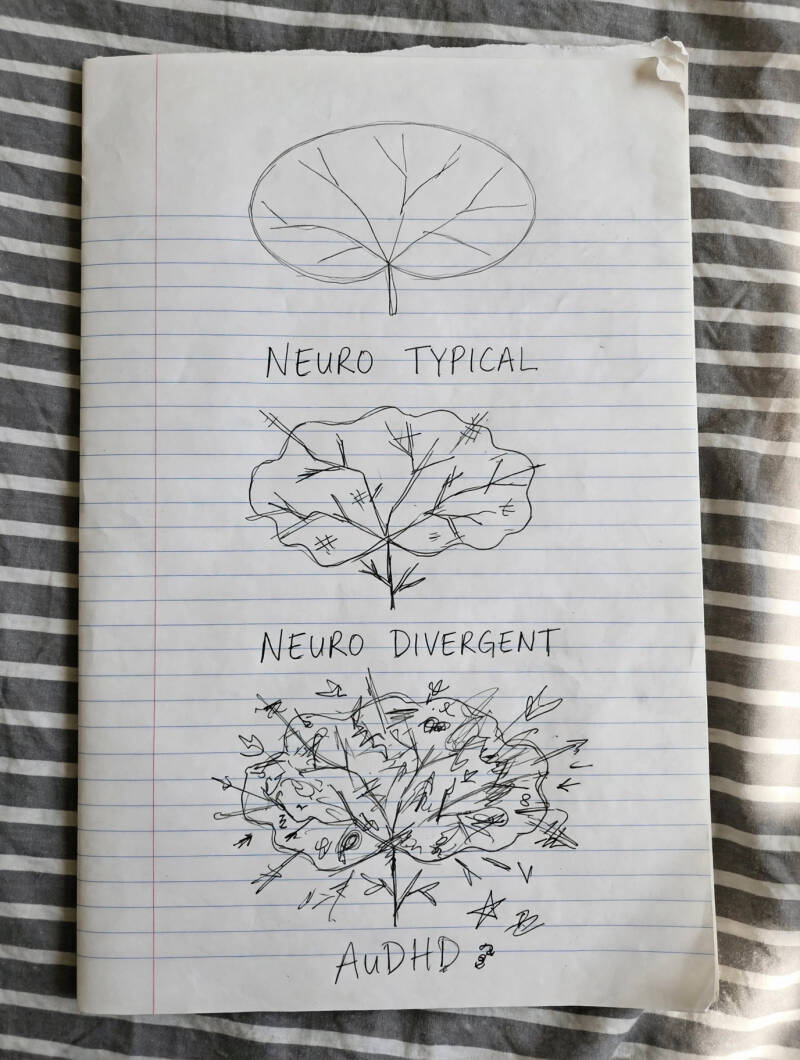
You might have seen the three-profile diagrams doing the rounds on Facebook and in reels — a flat line, a spiky line, and an even spikier one. We went hunting for the originals in Luke's saved posts and feeds; the closest matches were a three-column "Neurodivergent Trait Differences" chart shared in a Facebook group and a reel with three trait wheels — Autism, ADHD, AuDHD. We couldn't pull the original image files to republish them here, so the chart below is our own drawing of the same idea — an illustration, not the Facebook original, and not measured data.
Three profiles, one picture
Luke's hand-drawn pencil sketch on lined notebook paper: three brains stacked top to bottom. The first, labelled 'Neuro Typical', is smooth with a few gentle lines. The second, labelled 'Neuro Divergent', is busier, with more scribbled detail inside. The third, labelled 'AuDHD', is a dense, spiky tangle of lines.
Luke's own sketch of the three brain types — smooth for neurotypical, busier for neurodivergent, and a full spiky tangle for AuDHD. This sketch is an illustration of the idea, drawn from the research summaries below — not measured group data. No study has yet published a cognitive-profile meta-analysis of AuDHD as its own group, so the AuDHD profile is an inference, labelled as one.
What has actually been measured
The strongest measured evidence is for autism. Wilson (2024, Archives of Clinical Neuropsychology) pooled Wechsler test scores (WAIS-IV / WISC-V) from more than 1,800 neurodivergent children and adults:
97.3 / 96.9 — Autistic adults' mean verbal comprehension and perceptual reasoning — right in the typical range (population mean 100).
86.7 — Autistic adults' mean processing speed — 13.3 points below the mean, a large effect. Reasoning at the top, processing speed in a trough: that gap is the spike.
95.2 — ADHD adults' mean working memory — only slightly below average, with processing speed at 96.2. On these IQ subtests, ADHD looks almost even. Its spikiness lives in everyday executive function instead: starting, holding steps, managing time.
So why does a spikier brain work harder? Not at everything — at the tasks that land in a trough, and in a world that keeps asking for the troughs. Holding a routine, filtering noise, switching tasks, masking in a meeting: a flatter profile does these on autopilot, while a spiky brain pays for them with conscious effort, all day. The cost is context-dependent — the same person can look effortless on a peak task at 10am and be wrecked by an "easy" trough task at 11. That is why spikiness gets misread as laziness or inconsistency, and why the person themself asks: "I can do the hard thing — why can't I do the easy thing?" Because the easy thing is in a trough.
One honest correction to the popular picture: Most people are spiky to some degree if you test enough areas. The flat neurotypical line is an average — and nobody is actually the average. What differs is how far apart the peaks and troughs sit, which ones they are, and whether school, work and home happen to ask for the peaks or the troughs.
How common is the overlap?
Common — but there is no single settled number, and anyone quoting you one exact figure is overselling it. Here are the best pooled estimates, with their sources.
Of autistic people, how many also have ADHD?
Lai et al. 2019 — Lancet Psychiatry, 96 studies, confirmed diagnoses only (strictest): 28%
Micai et al. 2023 — 340 publications, ~590,000 participants (largest): 37%
Rong et al. 2021 — 63 articles, current ADHD: 38.5%
The estimates differ because clinical samples give higher figures than population samples, and age, recruitment setting and diagnostic criteria all move the number. Plain-English version: about 3 in 10 to 4 in 10.
And the other way around?
About 21% of children and teenagers with ADHD meet the threshold for autism (Hollingdale et al. 2020, 22 publications, 61,985 young people). Reviews often quote "20–50%", but that is a broad range from mostly child studies — adult figures in this direction are not well established, and this post won't pretend otherwise.
About that "50–70%" figure: Hours, Recasens & Baleyte (2022) describe 50–70% of autistic people presenting with ADHD — while noting individual studies range from 10% to 90%. That is a description of how wildly the literature spreads, not a pooled estimate. If you see it quoted as fact, you now know better.
Why the overlap is not chance: twin and family studies find moderate-to-strong genetic overlap between the two (genetic correlations around 0.33–0.72 depending on trait and sample). Shared genetics explains part of it — not all of it, and no single gene or percentage is settled.
In Australia: there is no direct count of AuDHD. The AuDHD Council of Australia models roughly 85,000–265,000 Australians from ABS 2022 figures (290,900 autistic Australians) and Deloitte Access Economics estimates for AADPA (533,300 adults with ADHD) — and labels it plainly as a modelled estimate, not a count. The true figure is unknown.
When the two meet: amplify, mask, clash
This is the heart of AuDHD. In one person, the two profiles do three different things — sometimes in the same afternoon.
They amplify each other
• Executive function, hit from two directions. ADHD makes starting and holding steps hard; autism makes switching and flexing the plan hard. Together: task paralysis, and a broken plan that derails the whole day.
• Sensory overload, faster. Autistic sensitivity plus weak ADHD filtering — overwhelmed by one input and under-stimulated overall, simultaneously.
• Emotional intensity. Feelings arrive fast and big, can be hard to name, and take longer to settle.
• Social cost, doubled. Manual decoding plus impulsivity in the moment — and longer recovery after.
• Burnout, both kinds at once. Masking and sensory load and deadline cycles and shame. (Autistic burnout itself is well defined — Raymaker et al. 2020; "AuDHD burnout" as a separate validated thing does not exist yet.)
They mask each other
• Autistic structure hides ADHD. Lists, routines and deep focus bury the disorganisation — the person looks organised because the scaffolding is doing the work, until it breaks.
• ADHD sociability hides autism. Talkative, funny, socially fluent in short bursts — the cost only shows afterwards, at home, alone.
• Hyperfocus hides both. It can look like strong attention or like a special interest — while quietly being the only way attention works at all.
• Each gets filed under the other. ADHD first? Rigidity becomes "frustration", sensory sensitivity becomes "hyperarousal". Autism first? Lateness, unfinished projects and volatility all become "just the autism" — and a treatable ADHD goes untreated for years.
They clash
• Novelty vs routine. Needing predictability and being bored senseless by it.
• Stimulation vs overload. Chasing intense input while one specific sound can shut the whole system down.
• Depth vs switching. Attention that is either all-in or gone — never the average of the two.
• Connection vs recovery. A deep desire for people, paired with rapid social burnout. Friends misread the quiet days as not caring. It is almost never not caring.
• The system cycle. Build a planner that finally works → it becomes boring → abandon it → rebuild. The problem was never discipline; the system served one need and starved the other.
The two epiphanies
For so many AuDHD adults, the story goes like this — not one lightbulb moment, but two, years apart. The first one explains half a life. The second one explains the rest.
Epiphany one: "I've got ADHD"
ADHD is usually recognised first because it is louder — the missed deadlines, the disorganisation, the interrupted conversations are visible and disruptive, so they get referred and named. The first realisation often lands in adulthood: after a child is diagnosed, a partner joins the dots, or a crisis — burnout, job loss, parenthood — breaks the old coping strategies. And it helps. Genuinely. But it doesn't explain everything — and the unexplained remainder quietly gets filed under "I'm just lazy / too much / not trying hard enough".
The in-between years
Meanwhile, the autism stays hidden — often by the ADHD itself. Once ADHD is on the chart, everything gets read through it (clinicians call this diagnostic overshadowing). The sociability and humour ADHD brings can paper over social exhaustion. And the masking — scripting conversations, forcing eye contact, suppressing stims, over-preparing to look organised — hides the traits from clinicians, from family, and often from the person themself. If you've scripted since childhood, you may not even know what your unmasked self feels like.
The mask falls
Something lowers the load in one place, and the other place becomes visible. Sometimes it's burnout — the mask drops because there's nothing left to hold it up. Sometimes it's parenthood, menopause, a child's diagnosis. And sometimes, remarkably, it's treating the ADHD: when medication quiets the noise, people start noticing the scratchy clothing tags, the desperate need for routine, the small talk they never actually knew how to do. Clinicians call this pattern stimulant unmasking — the medication isn't causing autism; it's revealing what was always underneath. Accommodating the ADHD can do the same thing, no medication involved.
Epiphany two: "I'm autistic too"
And then the whole life gets re-read. School reports. Friendships that faded. Jobs that never fit. Years of exhaustion that never had a reason. Research on late diagnosis describes a consistent emotional ride — Young et al. (2008) mapped six stages in adults diagnosed with ADHD: relief and elation, confusion and turmoil, anger, sadness and grief, anxiety, then accommodation and acceptance. A 2026 study of 225 late-identified people's posts (Autism journal) named the same territory the "Grief, Relief & Belief Cycle": grieving the life you could have had, grieving for your younger self, real gratitude — and, honestly, post-diagnosis burnout, because re-reading your whole life is exhausting work. People move back and forth between these. There's no fixed order and no timeline. But the direction of travel, again and again in the research, is from self-criticism toward self-compassion.
The honest footnote
This sequence — ADHD first, autism second — is one of the most commonly described paths in AuDHD life stories, and clinicians recognise it. The reverse happens too: autism diagnosed in childhood, ADHD missed for decades. But no study has ever counted how often each path happens, so we won't give it a percentage. What we can say is the AuDHD Council's version: many AuDHD adults reach midlife before the picture finally fits. If this is your story, you are not alone in it.
Why was it missed for so long?
Partly the rulebook: before 2013 the DSM treated the two diagnoses as mutually exclusive, so a whole generation was assessed under a system that forced a choice. Partly the criteria themselves, built mostly from observing boys — girls and women who mask more, whose interests look "typical", were diagnosed late or given anxiety, depression or personality-disorder labels first. When researchers screen whole populations instead of counting who's already diagnosed, the autism ratio comes out closer to 3 boys to 1 girl, not 4 or 5 to 1 (Loomes, Hull & Mandy 2017) — meaning girls who meet the criteria are disproportionately the ones missed. In Australia, the number of autistic females recorded by the ABS almost doubled between 2018 and 2022 (46,500 → 90,900) as recognition caught up.
Medication vs non-medication
First, the headline nobody should skip: medication and non-medication approaches do different jobs. Medication mainly changes core symptoms. Non-medication support changes the day-to-day impact — the environment, the systems, the skills around the symptoms. For autism, there is no medication for the core features at all. For AuDHD, the answer is almost never "one or the other".
Medication can
ADHD: Stimulants (methylphenidate, lisdexamfetamine) are first-line for adults with significant impairment — they reduce inattention, hyperactivity and impulsivity. Non-stimulants (atomoxetine, guanfacine) are alternatives. Symptoms ease; they rarely vanish completely.
Autism: Nothing for the core features — no drug treats social communication differences, the need for routine, sensory processing or focused interests. Risperidone and aripiprazole are approved only for irritability associated with autism. Other medicines treat co-occurring anxiety, depression, sleep problems or seizures.
AuDHD (both): The same ADHD medicines, on the same basis as anyone else (AADPA guideline, Rec 5.6.1) — but they treat the ADHD piece only. Australian guidance is explicit: dose changes slower, monitoring more often, because the person is also autistic (Rec 5.1.7).
Medication limits
ADHD: Side effects include appetite and sleep changes, anxiety, raised heart rate and blood pressure. Not everyone responds; not everyone wants it.
Autism: Antipsychotics for irritability carry a significant side-effect burden and are for specific indications — not general use.
AuDHD (both): Stimulants appear to work for a smaller share — roughly 49–50% of AuDHD people vs 70–80% of ADHD-only (secondary summaries of trial data) — with more frequent side effects: irritability, appetite loss, anxiety, sleep problems. Trials show modest benefit for ADHD symptoms, evidence quality rated low to very low, and adult evidence is thinner than child evidence.
Non-medication can
ADHD: CBT adapted for ADHD (an evidence-based recommendation for adults), psychoeducation as the base of every plan, coaching as part of a plan, plus sleep, movement and practical environmental strategies. No diet or supplement has good evidence as a treatment for adult ADHD.
Autism: Visual supports, speech-language therapy, occupational therapy for daily living and sensory participation, social-communication support, and CBT adapted for autistic people (e.g. for anxiety). Non-medication support is the treatment for autism itself.
AuDHD (both): Both sets, joined together and adapted for the clash: CBT that accounts for sensory load and literal processing; coaching that builds a flexible frame instead of a rigid routine; sensory and regulation work before executive-function work.
Non-medication limits
ADHD: Doesn't shift core inattention and impulsivity the way medication can; effects are smaller and depend heavily on fit. Evidence is mostly in children; adult evidence is thinner.
Autism: ABA is contested — some measured gains in young children alongside significant community concern about its aims and methods. Not a default adult support.
AuDHD (both): No trial has ever tested a combined AuDHD programme as one package. Guidance is assembled from the two single-condition guidelines — there is no treatment designed for AuDHD as one condition.
One more number, because it shows the joined-up thinking working: in an 8-week randomised trial of guanfacine XR in autistic children aged 5–14, hyperactivity scores fell 43.6% versus 13.2% on placebo (Scahill et al. 2015). And atomoxetine shows modest benefit for hyperactivity and inattention in autistic young people with a relatively gentle side-effect profile.
The takeaway
You don't have to be a "medication person" or a "non-medication person". The guideline answer is multimodal, personal, and revisited over time — ideally with a prescriber experienced in adult AuDHD. And if treating the ADHD makes autistic traits more visible, that's a signal to widen the assessment — not a reason to panic, and not the medication causing a problem.
Left undiagnosed: the later-life bill
No study has followed undiagnosed AuDHD people across a lifetime — that research doesn't exist yet. What follows is what the evidence for each condition shows, plus what late-diagnosed people consistently report. The pattern is not one big event. It's accumulation.
Mental health — the cumulative cost
A systematic review of undiagnosed and late-diagnosed ASD/ADHD (French et al. 2023, 17 studies) links going without a diagnosis to significant impacts on mental wellbeing and social life, and higher risks of substance abuse, accidents and offending behaviour, alongside lower income and education. Anxiety is the most common companion: in autistic adults, a meta-analysis found 27% with a current anxiety disorder and 42% across a lifetime (Hollocks et al. 2019). And decades of masking without a name for why is the mechanism late-diagnosed people describe most: camouflaging is consistently associated with worse anxiety, depression and suicidality.
The starkest figures need care. In a Swedish population study of more than 27,000 autistic people, premature mortality was markedly elevated (odds ratio 2.56) and suicide was among the largest differences — particularly for autistic people without intellectual disability (Hirvikoski et al. 2016). These are associations in mostly diagnosed populations, reflecting lack of support, victimisation and unmet needs as much as anything — not a prediction about any one person, and not proof that being undiagnosed itself is the cause. We include them because they show what's at stake in getting people support earlier — not to frighten anyone.
Work, money and relationships
The life-course pattern clinicians describe: school structure collapses in early adulthood and the regulation difficulties show; the 18–25 years bring job changes and relationship instability; sustained masking through the 25–40 years produces burnout episodes, often triggered by a major event — divorce, job loss, parenthood, a child's diagnosis — which is finally what prompts a proper look. Adults with ADHD earn less on average and change jobs more often. In relationships, the cycle repeats: intensity, then routine-phase friction over chores, money, follow-through and "not listening", then shame, then withdrawal — with both partners blaming the person instead of seeing the pattern.
Body and ageing
For ADHD, longitudinal research links persistence into adulthood with reduced life expectancy — driven not by ADHD itself but by the cascade around it: accidents (serious transport accidents run about four times higher in Swedish data, and lower during medicated periods), substance use, smoking, missed medical appointments and decades of poor sleep compounding. For autism, midlife brings a heavier physical-health load — epilepsy, gut problems, asthma, fatigue, pain — made harder to manage by clinics that are sensory-hostile and communication-unfriendly. And in older age, both conditions remain substantially underdiagnosed: traits get misread as anxiety, depression, personality, cognitive decline or "normal ageing". People now in their 50s, 60s and beyond grew up when none of this had a name.
Why a late diagnosis still matters
It doesn't undo the years, guarantee support, or fix a relationship on its own. But it changes what happens next: the right support instead of the wrong treatment, accommodations instead of apologies, and a different story about the past. Diagnosis is a first step — what matters is the wraparound care, practical and emotional, that follows it.
If this section landed hard
Reading about later-life effects can stir up a lot — especially if you're recognising your own story in it. In Australia, you can talk to someone any time:
Lifeline — 13 11 14 (24/7 crisis support)
13YARN — 13 92 76 (24/7, for Aboriginal and Torres Strait Islander people)
You don't have to be in crisis to call. And if the two-epiphanies story sounds like yours, a good first step is a longer GP appointment — see the Australia section below.
What actually helps
Most standard advice is written for one profile or the other — applied wholesale, it helps half the person and antagonises the other half. These ten strategies only make sense when you hold both needs at once.
1 Structure the day, not the minute. A rigid minute-by-minute schedule fails the ADHD side; no structure fails the autism side. What works: a predictable sequence with flexible contents — the same three or four anchors, in the same order, with real choice inside each block.
2 Build novelty in on purpose. Same time, same place, different thing — a variable slot inside the routine. Don't abandon the routine to get novelty; put the novelty inside it.
3 Minimum viable structure. Visible priorities instead of a long list, protected recovery, realistic buffers — and permission to change the method without abandoning the goal. Ask "what conditions made this possible last time?" instead of "why can't I be consistent?"
4 Put executive function outside the head. One trusted capture place (not five apps), visual sequences, one step at a time, and cues where the action happens — medication next to the coffee machine, not in a tidy drawer.
5 Regulation first, always. A dysregulated person can't use any organisational system. Sensory input before a demand prevents overload better than recovery after it. Transition warnings, protected quiet, a reliable shape to the day — then the planner.
6 Body doubling. A quiet, supportive presence — in person or online, camera off if needed — externalises accountability without adding social demand. It genuinely helps starting and sustaining.
7 A sensory-smart environment, both ways. Noise-cancelling headphones and a fidget or movement option. Dimmable light and a standing desk. A quiet reset space and music or pressure for focus. The same person may need both in one day.
8 Plan for the crash, not just the day. Recovery time booked after social events, low-energy task options for low-energy days, batch cooking and freezer meals, pre-written email templates, and a code word with friends for an early exit. These aren't extras — they're what makes the rest possible.
9 Let stimming and fidgeting work. Suppressing a harmless stim is exhausting and costly. A fidget tool, standing, moving while thinking — in a meeting, that's a support, not a disruption.
10 For Vale specifically. This is why Vale is built the way it is: voice capture that removes the cost of opening an app and typing, one visible next step instead of a full list, spoken reminders and transition warnings, a predictable daily shape with a novelty slot built in, and low-energy modes for low-energy days. (These are design choices drawn from the evidence above — Vale hasn't run a clinical trial, and won't claim otherwise.)
The accommodations examples are drawn from Willoway Psychology's lived-experience list of 50+ AuDHD accommodations (Australia) — practice-based wisdom, not trial evidence, and all the more useful for it.
One superpower for each brain
Luke asked for one superpower per category — so here they are, grounded in the research, with the honesty kept in: strengths are real and conditional. They show up when the conditions are right. They don't cancel out disability, not everyone in a category has them, and no superpower makes support unnecessary.
Category 1 · Neurotypical — The Bridge
Doing a bit of everything, switching easily, and reading the room without thinking about it. Automatic social fluency and even-enough executive function mean most everyday demands draw on a similar level of capacity — and generalists hold groups, teams and families together by translating between all the specialists. Grounded in Taylor's theory of complementary cognition (2021): populations thrive because generalists and specialists complement each other. The neurotypical superpower is not having a spike — breadth itself. It's also the superpower with an unfair advantage: the world is built for it.
Category 2a · ADHD only — The Novelty Engine
Divergent thinking — generating more original ideas, making fast connections between unrelated things, and bringing energy and hyperfocus to whatever genuinely matters. In brainstorming research, adults with ADHD produce a higher number of original ideas than control groups. The evidence is small and task-based (Sedgwick 2024, via NeuroKin Psychology's strengths review). Hyperfocus is a strength when the task is interesting and the conditions are right — and a liability when they're not.
Category 2b · Autism only — The Pattern Detective
Pattern recognition and depth — seeing the fine detail everyone else walks past, holding deep expertise, thinking systematically and honestly. Superior perceptual capacity and recall for detailed information show up again and again in the research, and are gold in data analysis, quality control and science. A group tendency, not a guarantee (Remington & Fairnie 2023). The same sensitivity to detail can overwhelm — and depth becomes a trap when the day demands switching.
Category 3 · AuDHD — The Spark
Depth that leaps sideways. Autistic depth, pattern-spotting and systematic thinking — plus ADHD's divergent jump-cut imagination and hyperfocus. The AuDHD Council describes it as seeing connections between things that look entirely unrelated, and focus that, when the conditions are right, reaches a level most people can't. This one is a synthesis, not a measured trial result — it follows from combining the two profiles, and AuDHD people describe it consistently. It doesn't work on demand. The whole point of support is making the conditions right more often, so the spark can catch.
Australia: pathways, costs and the NDIS
Prices, GP-prescribing rules and NDIS changes are all moving through 2026 — everything in this section was checked against sources dated November 2026, and you should re-check before relying on it.
Where to start
Book a longer GP appointment. The GP refers onward: a psychiatrist can diagnose both conditions and prescribe ADHD medication; a clinical psychologist can diagnose autism and assess ADHD. Autism assessment and ADHD assessment are separate processes — expect a combined assessment to take roughly 4–8 hours of clinician time across 2–4 appointments. A Mental Health Care Plan gives up to 10 partly-rebated psychology sessions a year — but note it subsidises therapy, not usually the assessment itself. Public waitlists are commonly 12+ months.
GP diagnosis and prescribing for ADHD — changing state by state
• Queensland: open since 1 December 2025 — GPs can diagnose, prescribe and start treatment for adults and children, no extra training required.
• South Australia: open for GPs who've completed additional training.
• New South Wales: staged — since September 2025 a GP may continue an existing psychiatrist's prescription; GP diagnosis and initiation expected around September–October 2026, with about 300 GPs beginning endorsed training in March 2026.
• Victoria: expected from around late 2026; first cohort of 150 GPs starts training September 2026.
• WA, Tasmania, ACT, NT: limited pathways, commitments without firm dates, or specialist-led — check audhd.org.au for the current state of play.
There's also a Medicare video option: item 92435 covers a psychiatrist ADHD assessment by video (schedule fee $549.90, benefit $467.45), claimable once per patient per 12 months.
What it costs (indicative, November 2026)
Private combined autism+ADHD assessments typically run $1,500–$4,500 with partial Medicare rebates (AuDHD Council). Real examples: MindScope charges $3,750 for a combined multidisciplinary assessment (autism alone $3,250, ADHD alone $2,500); NeuroNest's adult AuDHD assessment starts at $3,560 with a comprehensive report; Conscious Healthcare SA charges $2,500 combined. Practices set their own fees — always ask for the gap in writing before you book.
Does AuDHD change NDIS access?
Short answer: autism can open the door; ADHD on its own does not — and having both doesn't automatically mean more funding. Access is decided on functional impact, not the label. Level 2 or 3 autism sits on NDIS List A (likely to meet the disability requirements); Level 1 may qualify with strong evidence of reduced functional capacity. ADHD is on neither list — at 31 March 2026, only 169 participants had ADHD recorded as their primary disability, out of 6,807 with ADHD recorded at all, while autism was the primary disability for 338,099 participants. What a second diagnosis can do is strengthen the functional evidence — the combined load is exactly what a good comprehensive report should document. Even then, there's no guarantee.
Families with young kids: the pathway is changing
From 1 October 2026, children aged 8 and under with developmental delay and/or autism and low-to-moderate support needs start moving to Thriving Kids (state-delivered foundational supports) rather than the NDIS, fully by 1 January 2028.
What we don't know (and won't dress up)
• AuDHD is not a diagnosis. It's community and clinical shorthand for having both diagnoses. The idea that it's a distinct neurological profile — not just the sum of two — is supported by emerging research, not settled.
• The spikiest profile is inferred, not measured. Autism's spike is measured (Wilson 2024); ADHD's spike shows in everyday functioning rather than IQ subtests; no AuDHD-group meta-analysis exists yet.
• No counted rates exist for how often ADHD is diagnosed before autism, or how often ADHD treatment unmasks autism. Both are recognised, commonly described patterns — without percentages.
• "Rejection sensitive dysphoria" is a widely reported experience, not a diagnosis — the term was coined by one clinician and isn't in the DSM or ICD.
• Monotropism and the double empathy problem are theories with growing support — useful lenses, not proven mechanisms.
• Masking is associated with worse mental health (anxiety r ≈ 0.27, depression r ≈ 0.36 in meta-analysis) — association, not proven causation. Masking can also be a chosen, useful strategy; the cost is the issue.
• No AuDHD-specific treatment trials exist. Everything in the medication and what-helps sections is assembled from the two single-condition guidelines plus practice-based sources, labelled as such.
• Relationship and work outcome numbers for AuDHD specifically don't exist — so this post contains none.
• Costs, GP pathways and Thriving Kids dates are moving through 2026. Figures here were checked in November 2026; re-check before relying on them.
Sources
Prevalence & overlap
• Lai MC et al. (2019). Prevalence of co-occurring mental health diagnoses in the autism population. Lancet Psychiatry 6(10). pubmed.ncbi.nlm.nih.gov/31447415
• Rong Y et al. (2021). Prevalence of ADHD in individuals with autism spectrum disorder: a meta-analysis. Research in Autism Spectrum Disorders 83. sciencedirect.com
• Micai M et al. (2023). Prevalence of co-occurring conditions in children and adults with autism spectrum disorder. Neuroscience & Biobehavioral Reviews 155. researchgate.net
• Hollingdale J et al. (2020). Autistic spectrum disorder symptoms in children and adolescents with ADHD. Psychological Medicine 50(13). pubmed.ncbi.nlm.nih.gov/31530292
• Genetic overlap: Ghirardi L et al. (2019), Psychological Medicine. pmc.ncbi.nlm.nih.gov
Spiky profiles
• Wilson AC (2024). Cognitive profile in autism and ADHD: a meta-analysis of WAIS-IV and WISC-V. Archives of Clinical Neuropsychology 39(4). pubmed.ncbi.nlm.nih.gov/37779387
• Neurodiversity Directory — Spiky profile definition (Doyle; Grant 2009). neurodiversity.directory
• Executive functions in autism and ADHD — systematic review and meta-analysis (2024, 36 studies). mdpi.com
Diagnosis, masking & the two epiphanies
• Antshel KM, Russo N (2019). Autism spectrum disorders and ADHD. Current Psychiatry Reports 21:34.
• Hull L et al. (2017, 2020) — social camouflaging and the female autism phenotype; Loomes R, Hull L, Mandy W (2017) — male-to-female ratio in autism.
• Young S et al. (2008). The experience of receiving a diagnosis and treatment of ADHD in adulthood. Journal of Attention Disorders 11(4). researchgate.net
• Grief, Relief & Belief Cycle (2026). Autism 30(5):1344–1359. pmc.ncbi.nlm.nih.gov
• Zhang Y et al. (2025). Genetic profiles separating early- and later-diagnosed autism. Nature 646.
• DSM history: British Psychological Society · The Transmitter
• Stimulant unmasking (clinical teaching material): PsychHQ, ADHD ch. 6A. psychhq.com
Burnout, medication & later life
• Raymaker DM et al. (2020). Defining autistic burnout. Autism in Adulthood 2(2). doi:10.1089/aut.2019.0079
• Pharmacological interventions for ADHD symptoms in ASD — systematic review and meta-analysis. sciencedirect.com
• French B et al. (2023). Undiagnosed/late-diagnosed ASD and ADHD — mixed-method systematic review. Journal of Attention Disorders. pmc.ncbi.nlm.nih.gov
• Hirvikoski T et al. (2016). Premature mortality in autism spectrum disorder. British Journal of Psychiatry. pubmed.ncbi.nlm.nih.gov/26541693
• Hollocks MJ et al. (2019). Anxiety disorders in autistic adults — meta-analysis.
Guidelines, Australia & practice sources
• AADPA (2022). Australian Evidence-Based Clinical Practice Guideline for ADHD — summary of recommendations. adhdguideline.aadpa.com.au (PDF)
• AuDHD Council of Australia — What is AuDHD? audhdcouncil.com.au
• AuDHD Australia — assessment, state rules and funding. audhd.org.au
• NDIS — Thriving Kids. ndis.gov.au
• Clinic price examples: MindScope · NeuroNest Psychology
• Willoway Psychology — 50+ accommodations for AuDHDers (lived-experience list). willowaypsychology.com.au
• Strengths research summaries: NeuroKin Psychology · Frontiers in Education (2022)
This post is general information drawn from the sources above — it is not medical advice and it can't diagnose anyone. If you recognise yourself in it, the next step is a chat with your GP.
#Vale #spicyburritoDotcomDotAU #GEMprinciple #hopeium #NeuroSpicy #AuDHD #ADHD #Autism
Anchor your heart, you will find peace. ⚓❤️☮️
Add comment
Comments