

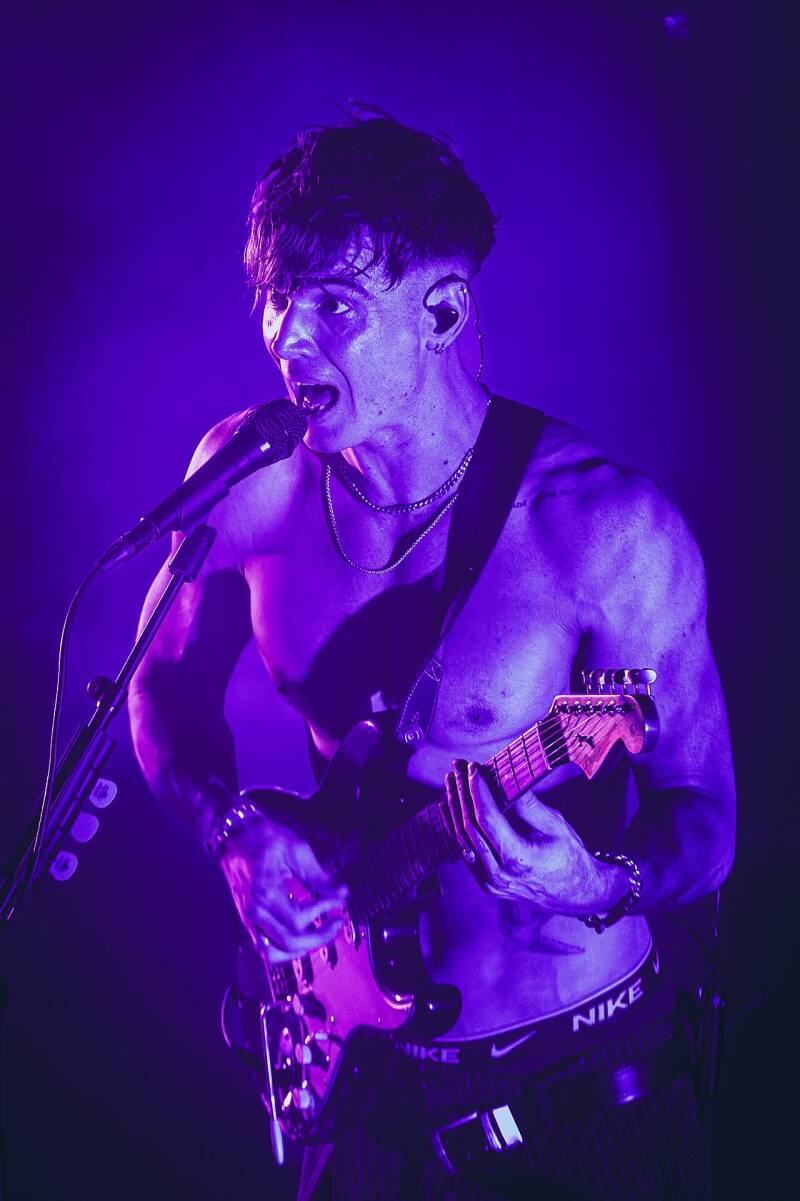
Ren Gill live in Glasgow. Photo: BenLPhoto, CC BY 4.0
Ren Gill live in Glasgow. Photo: BenLPhoto, CC BY 4.0
A bloke from Wales spent seven years in bed while doctors told him he was bipolar, depressed, and making it up. Then he picked up a guitar, sang the argument inside his own head out loud, and half the neurodivergent internet heard their own life in it. This one is for Ren, for The Big Push, and for everyone who's ever been given the wrong name for what's wrong.
I heard a bloke arguing with himself, and it sounded like my brain
The first time I heard "Hi Ren", I didn't know what I was listening to. One bloke, one guitar, nine minutes, in a bedroom in Brighton. And he's having a full-blown argument with the voice inside his own head. The voice says: "Hi there Ren, it's been a little while, did you miss me?" And Ren answers back, all reasonable, like he's just come from therapy: "I've been taking some time to be by myself, since my therapist told me I'm ill. I've been making some progress lately, and I've learnt some new coping skills." And the voice just laughs at him. That's the whole song. Two voices, one bloke, going back and forth for nine minutes. And by the end of it, Ren lands on the line that stopped me cold: "It was never really a battle for me to win, it was an eternal dance." I reckon that's the most honest thing anyone has ever said about living in a brain like ours. You don't beat it. You don't fix it. You learn the steps.
His name is Ren Gill. He's a Welsh singer-songwriter, rapper, busker, and the frontman of a Brighton street band called The Big Push. He's had a number one album in the UK. He's got millions of followers. And his story is one of the wildest I've ever heard — because the thing that nearly killed him wasn't the illness. It was being told, for seven years, that the illness was all in his head.
Seven years in bed
Ren's story starts in 2009. He was at Bath Spa University, in a band called Trick the Fox, and a producer spotted him busking and signed him to Sony. The dream, right? Recording contract, London studio, the whole thing. Then he got sick. Not a bit sick. Bedridden sick. At his worst he was in bed up to 23 hours a day. At one point he didn't get out of bed for a whole year. He went back to his mum's house in Wales to recover, and he just… stayed there. In bed. While his whole life fell apart around him.
He went from doctor to doctor and therapist to therapist, trying to find out what was wrong with him. And here is where the story turns into something that should make everyone furious. They told him he was depressed. Then they told him he was bipolar. Then they told him he had chronic fatigue syndrome. They gave him piles of psychiatric medication. And he just kept getting worse and worse. He developed stress-induced psychosis. He had a three-month stretch where he was terrified he was the subject of an experiment, or possessed. He lost one of his best friends to suicide. At his lowest, after a massive crash in 2015, he weighed eight stone and was going through months of psychosis. He thought he might not live much longer.
Here's what he said about those years himself: "Years before I was diagnosed correctly with autoimmunity, Lyme disease and brain damage, I was misdiagnosed as bipolar and spent years bouncing back and forth between therapists and trialling different antidepressants all the while getting worse and worse." Read that again. Years. Bouncing between therapists. Trialling different antidepressants. All the while getting worse and worse.
In October 2015, after he raised the money to see a specialist in Brussels, someone finally ran the right tests. Lyme disease. A tick bite. Seven years earlier. Easily fixed with antibiotics in the first few weeks after the bite — but by then it had been running wild in his system for seven years, triggering autoimmune problems and mast cell activation disorder and brain damage. Seven years. Seven years of being told the problem was his mind, when the problem was a bacterium in his blood.
He went to the United States for experimental stem cell treatment in 2017, and slowly, slowly, his body started to come back. Enough to busk again on the streets of Brighton. Enough to make music again. He still lives with fatigue and autoimmune issues and brain damage and PTSD. As recently as January 2023 he was in Canada getting intravenous infusions five days a week, and he went through an eight-month course of combination antibiotics for a Bartonella co-infection. But he's here. And he's singing about it.
The band that waited
While all of this was going on, there was a band. The Big Push started in 2017, four mates busking on the streets of Brighton. Three frontmen — Ren, Romain Axisa, and Gorran Kendall — swapping guitars and vocals, and Glenn Chambers on drums. They met the way buskers meet: Gorran and Romain bumping into each other on the street, Ren living in the same house as Romain, Glenn sitting in on a busk and never leaving. They did it the hard way. No label, no manager, no big break. Just the pavement, the crowds, and videos that people passed around hand to hand online until millions of people had seen them.
In June 2021 they released an EP called Can Do, Will Do and sold out a UK tour. In September 2022 they played their biggest venue yet, the Brighton Dome. And then, just before that Dome show, they told everyone it would be their last. Different countries, personal matters, the vagaries of life — and Ren's health. They busked together on the streets of Brighton for the last time on 14 December 2022, and that was it. Three years gone.
Here's what I love about this part. Nobody went off and sulked. They all went and did their own thing. Romain went solo and put out an album in 2024, The Radios Killed The Blues. Gorran went solo too, as just "Gorran", put out an EP called Grown Up in 2022, and went off hitchhiking and busking around Europe. Glenn lived a quieter life, travelled — including a stint here in Australia — busking now and then, posting drum jams on social media. And Ren, somehow, put out Sick Boi, and it went to number one in the UK in October 2023, beating Rick Astley.
Three years apart. Four blokes, four different lives. And then, this year, they came back. Five shows in May 2026 — Glasgow, Brixton, Bristol, Brighton, Manchester — the Brighton one at Chalk sold out. Then they spent the summer doing what they do best: turning up on the streets of Brighton with no warning and just playing. Guerrilla busking, the same as the old days. On the August bank holiday weekend, Ren was setting up outside Trinity Chapel on Ship Street and a crowd just gathered out of nowhere. And it all built to Sunday the 6th of September: a three-hour beachfront gig at the Kings Road Arches, the exact same spot where they'd busked to near-empty pavements seven years earlier. This time it was mobbed. Fans leaning over the rails, passers-by stopping, the whole seafront full of people. They're back in the studio too, with new music on the way. The story isn't over. It never really felt final, even when they split up.
The injustice isn't rare. That's the scandal.
Here's the bit that should make you angry, and it's not just about Ren. Ren's story is extreme, but the pattern behind it is everywhere. A patient registry called MyLymeData surveyed 3,903 people with Lyme disease, and 72% of them said they'd been given another diagnosis first. Of the ones who were misdiagnosed, 52% said they'd been told they had a psychiatric disorder. 43% were told it was fibromyalgia. 42% were told it was chronic fatigue syndrome. Half of them waited more than three years for the right diagnosis. Half of the chronic patients in that registry saw seven or more doctors before anyone got it right. Only one in ten was diagnosed in the first month.
Now, to be straight with you — that's a patient registry, not a count of every Lyme patient in the world. People who sign up for a registry are the ones who had a hard time. So don't quote those numbers as if they're the whole population. But even with that caveat, the shape of it is undeniable: when a body is doing something strange and complicated, the system reaches for the mental health label first, and it reaches for it hardest when the patient is a woman.
And the cost isn't just time. It's the wrong pills. Pills with side effects that make you worse. It's the years you lose. It's the trust you lose in doctors, in the system, in your own sense of what's real. Ren has said it straight: doing all the self-work, the CBT, the affirmations, the strict medication regimes, and ending up worse — "it shakes your trust in the medical system." That's not a Ren problem. That's a system problem. And if you've ever sat in a doctor's office knowing something was wrong with you and watched them write down a label that didn't fit, you already know exactly what I'm talking about.
It's the same story as my last blog, just wearing different clothes. Fifty, undiagnosed, told you were dumb. Ren, undiagnosed, told he was bipolar. Different label, same wound: someone in authority looked at a brain or a body they didn't understand, and blamed the person living in it.
Three songs that say what we can't
This is why Ren's music hits neurodivergent people the way it does. He doesn't sing about it from the outside. He sings from inside it.
"Neurodivergent" — his new one, out in May 2026 with the American rapper Chris Webby, on their album together as Inpatient, called Asylum. It's three minutes and fifty-two seconds of pure racing brain. "My focus goes, the world smoke machine." "My racetrack thoughts race cycling." And then the chorus, the question that is the whole song: "What makes a person / Neurodivergent?" And the answer he gives, in Webby's verse: "They told me I was broken / Nothing but a defect in my head." And then the line that floored me: "after all the pills that they got me, it turned me to a zombie." That's not a metaphor for Ren. That's his medical record, set to music.
"Hi Ren" — December 2022, the one that started all of this for most of us. Nine minutes, one guitar, one voice playing two parts. The voice that tells you you're worthless, and the voice that's trying to get better anyway. "I am you, you are me, you are I, I am we." You can't kill the dark voice without killing yourself, so you learn to dance with it. Fifty-nine million views on YouTube, and I reckon every single one of those people heard something they recognised. The internal dialogue. The critic that never shuts up. The masking — sounding fine while the argument rages inside.
"Sick Boi" — the title track of the number one album, and the angriest of the three. It opens in a therapist's office, and the therapist looks at his file and says, "Essentially, your mind is making you sick." And then Ren just lets rip: "Sick boy, sick boy, bitten by a tick boy." "Take another pill, here, take a couple more. Let's see how you're doing in another week or so. You'll be feeling worse when the side effects will show." "I've been feeling like I'm drowning with my feet upon the ground. I've been screaming, I've been shouting, but I never make a sound." If you've ever screamed inside your own head while smiling at the person in front of you, that line is your whole life in two sentences. And then he turns it around on the whole world: "I feel like it's not me, it's the world that's sick." That's the bit that makes neurodivergent people stand up and cheer. Because we've all had that thought. Maybe the problem isn't that our brains are wrong. Maybe the problem is a world built for one kind of brain, telling everyone else they're broken.
No script, no routine — just turn up and play
Here's the part that made me want to write this blog in the first place. The Big Push are a street band. That's not a cute detail, that's the whole thing. They turn up on a pavement in Brighton with their instruments, and they play. No stage. No script. No safety net. No setlist handed down from a manager. They read the crowd in front of them and they play what the moment needs. Sometimes it's their own songs. Sometimes it's a cover nobody saw coming — Bob Marley, The Police, "No Woman, No Cry" to a crowd that just happened to be walking past. And if the crowd isn't feeling it, they feel that too. There's nowhere to hide on a street corner. You're either connecting or you're not, and you find out in about ten seconds.
Now tell me that's not a neurospicy life. We don't do routine the way the world expects us to. We don't do the plan, the schedule, the same thing at the same time every day, the neat little boxes. We turn up, we read the room, we improvise, we do our best with whatever the day throws at us. Some days the crowd gathers and everything clicks. Some days it's near-empty pavements and you play anyway, because the playing is the point.
Ren knows this better than anyone. At the end of that big beachfront gig in September, he asked the fans not to swarm him — because, in his own words, he's "a neurodivergent mess" and crowds give him panic attacks. The bloke who just played for three hours to a mobbed seafront can't handle the crowd afterwards. If that doesn't describe the neurodivergent experience in one sentence, I don't know what does. All that energy, all that connection, and then the noise is too much and you need to go home and be quiet for a bit. That's not a contradiction. That's just how it works. The same brain that can hold a whole street spellbound for three hours is the brain that needs the quiet afterwards. The same brain that can't follow a routine can improvise something beautiful out of nothing. The street doesn't ask you to be normal. It asks you to be real. And that's why busking suits Ren, and that's why it suits us. No script. No pretending. Just turn up, read the room, and play what's in you.
Hold on
I want to finish with what Ren's fans say about him, because it says everything. They call themselves the Renegades. They're a devoted, mixed-up bunch, and a lot of them see themselves in his story: battling illness, losing friends, surviving trauma. They're not treating him like some kind of messiah. It's simpler than that. It's relief. Relief that they're not alone in their thoughts and feelings. Relief that someone finally said the thing out loud. And Ren's message to them is simple too. Hold on.
So here's mine. If you've been given the wrong name for what's wrong with you — dumb, lazy, bipolar, broken, too much, not enough — that name was never yours. It was their guess, and their guess was wrong. The real story is still in there, waiting for the right person to ask the right question. And if your days feel like busking — no script, no routine, just turning up and reading the room and doing your best — then you need tools that work that way too. Not a planner that punishes you for being spontaneous. Not a calendar that makes you feel stupid for forgetting. A planner that works with your brain, not against it. That's why I built Vale. One clear view of the day, your way, with the people who hold you together able to see it too. Ren found his voice on a street corner in Brighton. You don't have to find yours there. But you do have to find it. And when you do, sing it loud enough that the next person hears it and realises they're not alone either. Woot woot. Hold on. Anchor, heart, peace.
#Vale #spicyburritoDotcomDotAU #GEMprinciple #hopeium #NeuroSpicy
What we don't know (honesty box)
- The MyLymeData figures come from a patient registry of people who had a hard road to diagnosis. They show the shape of the problem, not a population-wide rate. There is no single reliable percentage for how often Lyme is misdiagnosed.
- The claim that the song "Neurodivergent" was inspired by TikTok creator Lady Cin appears in online summaries but I could not verify it from a primary source, so I left it out of the post.
- "No setlist" is my characterisation of street busking, not a quoted fact from the band. What is verified is that their busking is spontaneous and guerrilla-style, and that they read the crowd and play covers and originals as the moment takes them.
- Ren's weight of eight stone at his lowest point comes from a secondary profile, not from Ren directly.
- Stem cell treatment for Lyme is experimental. Ren has spoken about it openly, but it is not an established treatment, and this post isn't medical advice.
- The Big Push's new album is described by promoters as "new music" in the works and by one local magazine as rumoured. No release date has been announced that I could find.
- Ren has never claimed to be autistic or ADHD. He has called himself "a neurodivergent mess" and his music resonates with neurodivergent listeners — that's the claim in this post, and that's as far as it goes.
Add comment
Comments