

I keep coming back to this picture.
You've seen it a thousand times. It's on t-shirts and coffee mugs and posters in classrooms. A giant wave curling over the sea, white foam fingers reaching down like claws. Most people look at it for about three seconds and move on. I did too, for years.
Then I actually stopped and looked at it. And it's not the picture I thought it was.
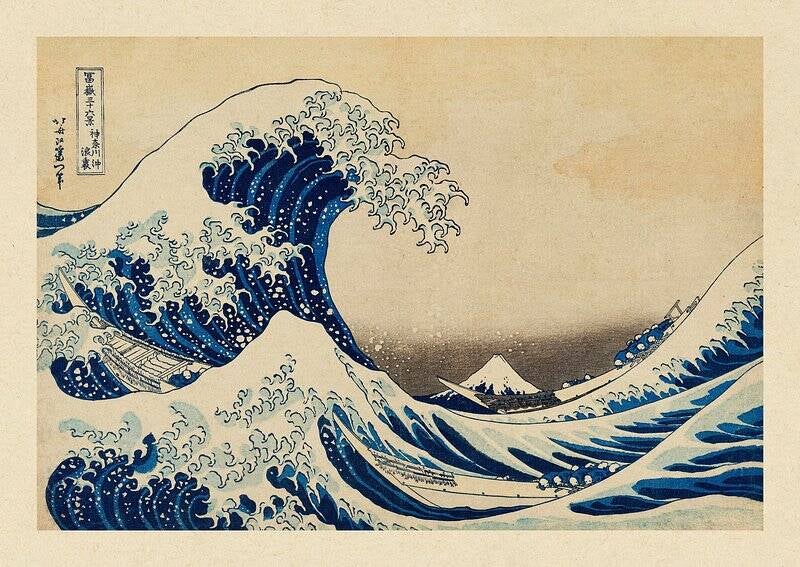
Its real name is Under the Wave off Kanagawa. A Japanese artist called Katsushika Hokusai made it around 1831, nearly two hundred years ago. And here's the first thing most people miss: it's not a painting. It's a woodblock print. Hokusai drew the design, craftsmen carved it into cherry-wood blocks, one block for every colour, and a workshop printed it again and again. Thousands of copies. There is no single original hanging in one museum. The blocks themselves are long gone. The image survived because it was made to be shared.
Listen to the episode while you read
The second thing people miss is what's actually in it. It's not just a wave. Look closer and there are three long boats underneath it, low in the water, crews bent over their oars, heads down. They aren't fishermen out for a fun day. They're working boats — fast cargo boats rushing fresh fish from the bay into Edo, which is Tokyo today. Delivery crews, doing a dangerous run they did all the time. And behind them, small and still and snow-capped in the hollow of the wave, sits Mount Fuji.
The wave gets all the attention. The mountain is the whole point. That's the first thing this picture taught me about my own head.
The wave
I know what that wave feels like, because I live inside it.
A hundred thoughts at once and I can't catch a single one. That's not a line I made up for this blog — that's a Tuesday. The phone buzzing, the calendar shouting, the thing I forgot, the thing I'm late for, the noise from the street, the song stuck in my head, the worry about money, the worry about the kids, the worry about the thing I said yesterday that I shouldn't have said. It all arrives at the same time. It doesn't queue up politely. It crashes in, all at once, and for a minute there you honestly believe it's going to swallow you whole.
That's the neurodivergent flood. That's what sensory overload is. That's what a busy brain does when the world turns the volume up. Everything is urgent, everything is loud, everything is now. And the wave is beautiful, too — that's the part nobody tells you. The curl of it, the colour of it, the sheer power of a brain that can see ten things at once. It's terrifying and it's magnificent in the same breath. Hokusai knew that. He painted the terror and the beauty in the same wave.
And look at the top of it. The crest breaks into fingers of foam, sharp and curled. Nearly sixty years after Hokusai made this print, Vincent van Gogh looked at it and wrote to his brother Theo about it. He was in Arles, in the south of France, in September 1888, and he wrote: "these waves are claws, the boat is caught in them, you can feel it."
Claws. He saw it too. The thing that reaches for you and grabs hold and won't let go. Van Gogh knew that grip. He lived with a mind that grabbed him by the throat. And still — still — what he saw in that wave wasn't only the fear. He saw the drawing, the lines, the feeling. He said if you made the colour too correct or the drawing too correct, you wouldn't create those emotions. The imperfection is the point. The mess is the point.
Anxiety has claws. I know it does. But even the man who knew those claws best looked at this wave and saw something worth staring at.
The mountain
Now look past the wave. Look at what's sitting behind it, small and pale and almost perfectly still.
Mount Fuji. Three thousand seven hundred and seventy-six metres of volcano, and in this picture Hokusai made it tiny. A little triangle of snow in the hollow of the wave. It doesn't shout. It doesn't move. It just sits there while the whole sea tries to eat it.
People in Japan have climbed that mountain as an act of faith for centuries. Pilgrims set out from the shrines at its foot, washed themselves in the lakes and springs on the way up, and walked around the crater at the top. It's on UNESCO's World Heritage list now, under the name "Fujisan, sacred place and source of artistic inspiration". Sacred. Not because it's dramatic. Because it endures. Because it's still there after every storm.
That's the still centre. That's the part of the picture I need most.
Underneath the flood in my head, underneath the hundred thoughts and the noise and the claws, there is a still place. It's small. Most days I have to look hard to find it. But it's there, and it doesn't move. It's the part of me that knows who I am when the wave passes. It's the breath before the answer. It's the anchor.
Anchor your heart and you will find peace. I've said that a hundred times now and I'll say it a hundred more, because it's the truest thing I know. The wave is temporary. The mountain stays. The hard moments are temporary. The person endures.
Hokusai even drew the mountain the same shape as the wave — the same triangle, the same colours — but the other way around. The wave is the mountain, upside down and in motion. The mountain is the wave, standing still. They're made of the same stuff. The chaos and the calm aren't two different things. They're the same mind, seen from different sides.
The boats
And then there are the boats. Three of them. Small, fragile-looking, crews working together, still afloat in the middle of it.
I love the boats most of all, because the boats are us.
They're not heroes. They're not victims. They're workers. Heads down, oars in the water, doing the job in front of them while the biggest wave they've ever seen hangs over their heads. They don't look like they're going to make it. They haven't sunk yet either.
That's what getting through a hard day actually looks like. Not some big heroic moment. Just rowing. Just the next thing. Just one small thing, and then the next one. The crews in those boats aren't looking at the wave. They're looking at their oars. They're looking at each other.
That's what we do for each other, too. The partners who hold it together. The mates who show up. The Shells of this world, who sit in the boat next to us and row when we can't. Nobody gets through a wave like that on their own. The boats are small, but there are three of them, and they're in it together.
The picture keeps changing
Here's the last thing about this print, and it's the thing that hooked me hardest.
The longer you look at it, the more it changes. First you see the wave. Then you see the boats. Then you see the mountain. Then you notice the wave is framing the mountain, curling around it like it's trying to protect it and destroy it at the same time. Then you notice the mountain echoes the wave. Then you notice the whole thing is printed in a blue that didn't even exist in Japan a few years before — a brand-new colour, Prussian blue, shipped in from the other side of the world, brighter and tougher than anything they'd had. Hokusai was seventy years old and he was still trying new colours.
A neurodivergent mind does that with everything. We don't see one picture. We see the layers, the patterns, the five meanings sitting on top of each other. Where someone else sees a wave, we see the wave and the boats and the mountain and the colour and the man who made it and the letter van Gogh wrote about it and what it all means about Tuesday. That's not a broken way of seeing. That's a richer one. It's harder to live with, and it's worth more.
Hokusai himself said it best. He wrote it down when he was seventy-five, looking back on his whole life: nothing he drew before seventy was worth counting. At seventy-three he was only just starting to understand how things are put together. At a hundred he thought he might finally get it right. At a hundred and ten, he said, every dot and every line would be alive.
He made his most famous picture at seventy, after a lifetime of getting it wrong. He died at eighty-nine, still asking for ten more years so he could become a real painter.
So if you're fifty and undiagnosed. If you're forty and only just working out why your brain does what it does. If you're seventy and starting again. You're not late. You're right on time. The man who made the Great Wave was seventy and just getting started.
The wave passes
The wave in that picture never crashes. It's frozen, right at the top of the curl, forever about to come down. But real waves crash. Real waves pass. And the mountain is still there afterwards.
That's what I want you to take from this. Not that the hard days don't come — they come, and they come with claws. But they pass. They always pass. And underneath them, the still part of you is still there, waiting. It was never washed away. It was never the wave's to take.
So when the flood comes — and it will come, probably before lunch — don't fight the whole sea. Find the mountain. One breath. One small thing. Let the rest wait. The boats are still afloat. The crew is still rowing. And the mountain hasn't moved an inch.
Anchor your heart. You will find peace. ⚓❤️☮️
#Vale #spicyburritoDotcomDotAU #GEMprinciple #hopeium #NeuroSpicy
Add comment
Comments