

Dyslexia, dyscalculia and dysgraphia don't disappear when you leave school. For a whole generation of Australians now in their fifties, nobody ever gave them a name — and the cost of that silence is still being paid. This one is for the ones who were missed, and for the women who were missed most of all.
I left school thinking I was dumb
If you went to school in Australia in the seventies or eighties and reading, writing or numbers didn't click for you, chances are nobody ever sat you down and explained why.
There was no screening. There was barely a word for it. What there was, was a label. Slow. Lazy. Stupid.
Andrew Fildes, who founded SHINE after his own childhood in that era, put it plainly: kids who couldn't speak or read clearly were "quickly labeled" — slow, lazy or stupid — and families were left with little literature and few options. Poet Michael Muriniti, schooled in the late eighties, says the same: called stupid, lazy and slow, and "I don't think a single solid attempt was made to make me try and understand or tackle things from a different angle."
The system back then ran on something called the IQ–achievement discrepancy model. Roughly: you only counted as having a learning difficulty if your test scores showed a big enough gap. If you struggled but didn't fail in exactly the right way, or if your school just never tested you, you were missed. And if you were a quiet kid who tried hard and never made a fuss, you were missed twice over.
So a whole generation walked out of school carrying a story about themselves that was never true. Not "my brain processes language differently." Just: "I'm dumb."
That story doesn't stay at school. It follows you into every job, every form, every parent-teacher night, every bill. Fifty years of it adds up.
Three different brains, one label
Dyslexia, dysgraphia and dyscalculia are three distinct Specific Learning Disorders. They are lifelong neurodevelopmental differences. They are not a measure of intelligence, and they are not a measure of effort.
The three conditions are:
- Dyslexia — affects reading and language: decoding words, matching letters to sounds, spelling, reading fluency.
- Dysgraphia — affects writing: handwriting, grip, spacing, getting thoughts onto paper in order.
- Dyscalculia — affects numbers: number sense, quantities, maths facts, charts, clocks, money.
In the DSM-5 they're grouped under one diagnosis — Specific Learning Disorder — with a specifier for reading, written expression or maths. The familiar names are the specifiers. The point is the same either way: these are wiring differences, not character flaws.
They travel together
Here's the bit most people don't know: these three rarely travel alone.
Reading impairment dominates diagnosed learning disorders — about 80% of people with a diagnosed Specific Learning Disorder have an impairment in reading. Maths and written-expression difficulties are less often the primary diagnosis on the paperwork, but they're very often there underneath.
Fifty to sixty percent of people with dyslexia have some difficulty with maths. About a quarter meet the symptoms for dyscalculia outright. And the overlap runs both ways: about 30 to 40% of people with dyscalculia also have a reading disorder.
Dysgraphia rides along with dyslexia more often than it shows up on its own — somewhere between 30 and 47% of people with dyslexia also have dysgraphia symptoms.
Why? They share some of the same underlying wiring: working memory, phonological processing (breaking words into sounds), and rapid naming. It's a partial overlap, not one single cause — but it's enough that if you struggle in one area, the odds of struggling in another go up sharply. Which is exactly why a proper assessment looks at all three areas together, not just the one that got you through the door.
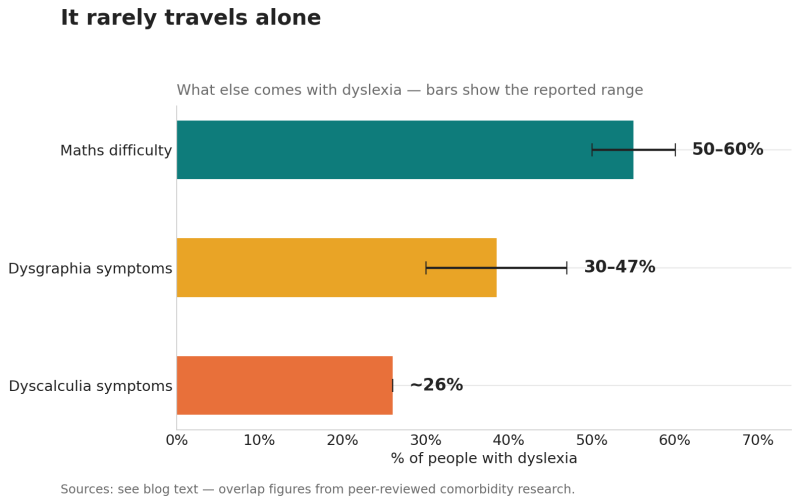
It rarely travels alone — what else comes with dyslexia
What fifty years of not knowing does to you
This is the part that matters most, and it's the part nobody warned us about.
Your mental health. In Dyslexia Scotland's 2024 survey of 1,420 dyslexic adults, 45% reported depression and 62% reported anxiety — about three to four times the general population. And the earlier someone was identified, the less severe the impact. The distress doesn't come from the dyslexia itself. It comes from years of academic struggle, stigma and low self-esteem. The link is association, not proven causation — but the pattern is consistent everywhere researchers look.
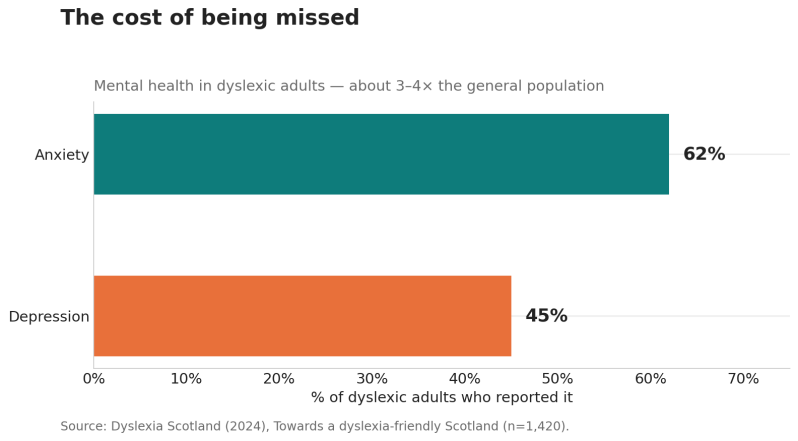
The cost of being missed — mental health in dyslexic adults
Your education and income. A 30-year longitudinal study that followed 1,344 people from age seven into midlife found that those with a reading disability at seven were 74% less likely to attain higher education and 56% less likely to attain a higher income as an adult. Education did most of the damage in between — the reading difficulty closed doors at school, and the closed doors did the rest.
Your relationships. The evidence here is mostly qualitative, but it's consistent: difficulty forming social relationships, embarrassment and shame in social settings, hiding literacy struggles from a partner. In 1972, two doctors wrote up seven adult patients whose illiteracy had only emerged after intensive examination — they'd hidden it from employers, friends and children, and "marital friction is common." Fifty years on, the hiding hasn't gone away. It just got better at passing.
Your coping — and what it costs. People get good at working around it. Memorising. Over-preparing. Rehearsing. Counting ahead so you're never caught cold reading aloud. Delegating the writing. Choosing jobs that keep the hard thing at a distance. Calling instead of emailing. Keeping notes to a few scattered words.
It works, until it doesn't. Masking like that is exhausting, and the neurodiversity literature links it to burnout, anxiety and depression. You can spend fifty years being the person who never reads aloud, never writes the report, never volunteers for the maths — and nobody ever asks why.
The boys got spotted. The girls got missed.
This is the part that should make everyone angry.
For dyslexia, the true prevalence is roughly equal between boys and girls. The famous Connecticut Longitudinal Study (Shaywitz, 1990) tested whole classrooms rather than waiting for referrals, and found reading disability in 8.7% of boys and 6.9% of girls in grade two. No significant difference.
But school identification in those same children? 13.6% of boys. 3.2% of girls.
The boys were spotted because their frustration showed up as behaviour — disruption, acting out — and behaviour gets a teacher's attention. The girls went quiet. They over-prepared. They shut down. They said "I forgot" or "I'm tired." They hid behind perfectionism and a determination not to be embarrassed. And nobody referred them, because nobody noticed.
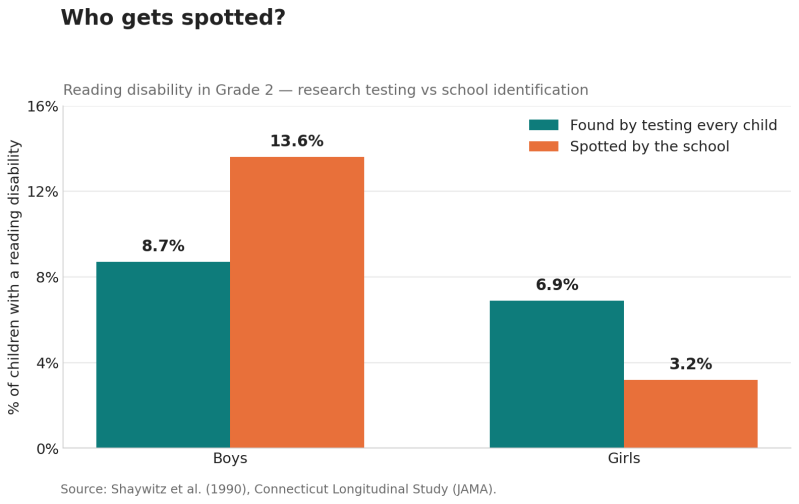
Who gets spotted? Research testing vs school identification
For dyscalculia, the best studies find it roughly one-to-one between the sexes — and it's under-identified in both. Girls do show higher maths anxiety, and more dyscalculia-plus-anxiety together.
For dysgraphia, boys are identified two to three times more often — but nobody can say whether that's real or just the same referral bias wearing a different hat. There is no population-screening study for dysgraphia like the one Shaywitz did for dyslexia. The honest answer is: we don't know.
And here's the honest line for the whole comparison: we know girls were missed more often at school. We do not have good evidence on whether undiagnosed women at fifty have worse mental health or employment outcomes than undiagnosed men. That study has not really been done for dyslexia, and barely at all for dyscalculia and dysgraphia. Anyone who tells you otherwise is guessing.
Numbers and writing, not just reading
Dyslexia gets the attention. The other two get the silence. So here's what they look like at fifty.
Dyscalculia in adult life: checking you got the right change. Splitting a restaurant bill. Budgeting for the month. Reading a timetable. Telling the time on an analogue clock. Remembering a PIN or a phone number. Estimating how long a trip takes. Following a medication dosage. Spreadsheets, rotas, invoices, targets. One woman quoted by the British Dyslexia Association put it plainly: "I still can't tell the time without difficulty, and I don't have a natural sense of time. I struggle to manage my own finances without help."
Dysgraphia in adult life: emails, reports, case notes, meeting minutes, forms. Writing tasks that take far longer than they should and leave you disproportionately exhausted. Hand cramps and a tense grip. Clear ideas in your head that jam up at the pen. Avoiding promotion because of the amount of written work involved. Worrying colleagues will judge your handwriting.
The evidence for dysgraphia in adults is the thinnest of the three — there are no good adult prevalence or outcome studies for it. That doesn't mean it isn't real. It means nobody has bothered to count it yet.
You're not the only one who found out late
- Steven Spielberg was diagnosed around sixty. It took him more than two years to learn to read. He was bullied, he dreaded reading aloud, and he called the diagnosis the last piece of a puzzle.
- Jamie Oliver was formally diagnosed in January 2025, at fifty, while filming Jamie's Dyslexia Revolution. He has said he has only read two narrative books in his life.
- Cher was diagnosed at thirty, after her son was tested — with dyslexia and dyscalculia. "Math was like trying to understand Sanskrit." She couldn't dial long-distance numbers because she transposed them.
- Charles Schwab was diagnosed in his forties, after his son was assessed. He built a business by hiring people for the things his brain didn't do well.
- Henry Winkler was diagnosed at thirty-one. "How you learn has nothing to do with how great you are."
And closer to home: Michael Muriniti, the Australian poet, wasn't told he had dyslexia until around age twelve, and only understood it as an adult. Andrew Fildes built SHINE out of his own seventies childhood. The Australian conversation is carried by advocates and community voices more than celebrities — and honestly, that makes it more real, not less.
What helps at fifty
A late diagnosis. The consistent finding is a mixed response, and both halves are normal: relief and validation, and frustration, grief and anger at how late it came. A diagnosis lets you reframe fifty years of difficulty as a neurological difference instead of a personal failure. It doesn't cure anything, and on its own it doesn't unlock funding — but it gives you the language to advocate for yourself, and the evidence base to ask for adjustments.
Getting assessed. In Australia, a formal diagnosis usually comes from a registered psychologist — cognitive testing plus achievement testing plus a history interview, typically two to four hours of testing and a report. As a guide to what it costs right now: SPELD NSW charges $1,845 for a literacy or numeracy assessment ($1,695 for members), $2,100 for both ($1,950 members), with the report in about six weeks. Private practices generally run from about $1,250 to $3,465. Medicare does not cover learning assessments. No published wait times exist — ring two or three providers and ask. A cheaper first step is the Australian Dyslexia Association's pre-assessment service for adults, which can tell you whether a full assessment is worth pursuing.
Your rights at work. Dyslexia is recognised as a disability under the Disability Discrimination Act 1992, and employers must make reasonable adjustments unless that would cause unjustifiable hardship. You don't have to disclose your full history — disclosing the adjustment you need is often enough. The JobAccess Employment Assistance Fund can pay for workplace changes and equipment, including screen-reading and speech-recognition software. And no — a dyslexia, dyscalculia or dysgraphia diagnosis on its own generally does not qualify you for the NDIS. Don't let anyone promise you that.
Assistive tech. Read-aloud tools are built into your phone and browser already. Dictation is built in too. Calculators, word prediction, spellcheckers, mind-mapping apps. Text-to-speech has a modest but real evidence base for reading comprehension. None of it removes the underlying difference. All of it lowers the daily cost of living with it.
Community. SPELD NSW runs a free InfoLine. The Australian Dyslexia Association has a directory of professionals and a pre-assessment service. There are peer groups like Dyslexia Support Australia. What we couldn't find is a national adult peer-support network for specific learning disorders in Australia — nothing like what exists for autism and ADHD. If you've found community somewhere, tell us where. Someone reading this needs it.
It's never too late to get the name for it
Fifty years of thinking you were dumb is a long time to carry a story that was never true.
The name doesn't change your brain. It changes the story. And once the story changes, everything downstream of it — the shame, the hiding, the jobs you didn't apply for, the forms you avoided — gets a chance to change too.
That's why Vale exists. A planner built for brains that work like this. One that doesn't punish you for how your brain files things, and doesn't make you feel stupid for needing the day laid out in a way you can actually use.
If this is you — or if this is someone you love — you are not dumb, you were never dumb, and you are not alone. Woot woot. Go find the name for it. ⚓❤️☮️
#Vale #spicyburritoDotcomDotAU #GEMprinciple #hopeium #NeuroSpicy
What we don't know (honesty box)
- Nobody has counted how many Australian adults reach their fifties undiagnosed. The numbers in this post are prevalence-based inference, not a measured count.
- There is no good sex-split data on adult outcomes for these conditions. We know girls were missed more at school; we don't know how that plays out at fifty.
- Dysgraphia in adults has no adult prevalence study and no adult outcome study. Dyscalculia in adults has no Australian adult prevalence figure.
- No published wait times exist for adult assessment in Australia.
- Mental-health links are associations explained by struggle, stigma and self-esteem — not proven causation.
Sources
- American Psychiatric Association, What Are Specific Learning Disorders? — https://www.psychiatry.org/patients-families/specific-learning-disorder/what-is-specific-learning-disorder/
- Siegel (2006), Perspectives on dyslexia, Paediatrics & Child Health — https://pmc.ncbi.nlm.nih.gov/articles/PMC2528651/
- Shaywitz et al. (1990), Connecticut Longitudinal Study, JAMA — https://pubmed.ncbi.nlm.nih.gov/2376893/
- Devine et al. (2013), dyscalculia prevalence — https://pmc.ncbi.nlm.nih.gov/articles/PMC4461157/
- Haberstroh & Schulte-Körne (2019), The Diagnosis and Treatment of Dyscalculia — https://di.aerzteblatt.de/int/archive/article?id=205469
- Ashraf & Najam (2020), comorbidity of SLDs — https://pmc.ncbi.nlm.nih.gov/articles/PMC7674906/
- Dyslexia Scotland (2024), Towards a dyslexia-friendly Scotland (n=1,420) — https://dyslexiascotland.org.uk/wp-content/uploads/2024/10/Towards_a_dyslexia-friendly_Scotland_report.pdf
- Stark & Johnson (2025), Annals of Dyslexia — https://link.springer.com/content/pdf/10.1007/s11881-025-00336-z.pdf
- McLaughlin, Speirs & Shenassa (2014), 30-year longitudinal study of reading disability, education and income — https://www.researchgate.net/publication/230864242_Reading_Disability_and_Adult_Attained_Education_and_Income_Evidence_From_a_30-Year_Longitudinal_Study_of_a_Population-Based_Sample
- Saunders & Barker (1972), BMJ — https://pubmed.ncbi.nlm.nih.gov/4646506/
- Queen Margaret University (2026), The Silent Struggle: late-diagnosed dyslexia in adults — https://eresearch.qmu.ac.uk/items/c3577c48-4d99-4ba9-ba0d-6cb8572aa8ac
- Reid (2025), UWE thesis on dyslexic women's experiences — https://uwe-repository.worktribe.com/index.php/OutputFile/16160307
- Australian Dyslexia Association, adults — https://dyslexiaassociation.org.au/adults/
- AUSPELD / DSF, Specific Learning Disorders flow chart — https://auspeld.org.au/wp-content/uploads/2019/08/Old-DSF9214_SLD-Flow-Chart_4P-Flyer-V3_WEB_View.pdf
- ADCET, What is a Specific Learning Disability — https://www.adcet.edu.au/oao/for-disability-practitioners/what-is-a-specific-learning-disability
- SPELD NSW, assessments (prices checked 20 Nov 2026) — https://www.speldnsw.org.au/services/assessments/
- SPELD Victoria, assessments — https://speldvic.org.au/assessments/
- JobAccess, Employment Assistance Fund — https://www.jobaccess.gov.au/i-am-a-person-with-disability/looking-applying-job/government-services-help-you/funding-workplace-changes/what-eaf-can-cover
- SHINE, Andrew Fildes — https://www.shine.org.au/stories/andrew-fildes-founder-director
- Dystinct, Michael Muriniti — https://on.dystinct.org/dystinct-journey-michael-muriniti/
- WPS Publish, dyslexia comorbidities — https://www.wpspublish.com/blog/dyslexia-comorbdities-what-you-need-to-know
- Edublox, dyscalculia statistics — https://www.edubloxtutor.com/dyscalculia-statistics/
- British Dyslexia Association, Dyscalculia Day 2026 — https://www.bdadyslexia.org.uk/news/dycalculia-day-2026
- University of Michigan DyslexiaHelp, Cher — https://dyslexiahelp.umich.edu/success-story/cher/
- Pearson Assessments, Dyslexia, dysgraphia, dyscalculia — oh my — https://www.pearsonassessments.com/professional-assessments/blog-webinars/blog/2026/04/dyslexia-dysgraphia-dyscalculia-oh-my.html
Add comment
Comments